Bringing a dog home for the first time is one of the most rewarding decisions a person can make. It is also one of the most underestimated. The first year of dog ownership sets the tone for everything that follows — your dog’s behavior, their health habits, their confidence around people and other animals, and the bond the two of you will share for years to come.
This guide is written specifically for first-time dog owners who want to do things right from the beginning. Whether you have just brought home a puppy or recently adopted an adult dog, the fundamentals covered here will help you navigate year one with confidence — and avoid the most common mistakes new owners make.
What to Expect in Your First Year as a Dog Owner
Year one is a period of adjustment for both you and your dog. Even the most prepared owners find it more demanding than expected — not because anything has gone wrong, but because a living animal has needs that do not pause for busy schedules, bad weather, or stressful weeks at work.
Understanding what lies ahead helps you plan. In the first twelve months you can expect to navigate your dog’s initial health care and vaccination schedule, establish a daily routine, work through the basics of training and socialization, manage common behavioral challenges, and figure out what your dog needs when you cannot be there. Each of these areas deserves real attention — and each one is covered in the sections below.
Setting Up Your Home Before Your Dog Arrives

Preparation before your dog comes home is not optional — it is essential. A dog-proofed, well-equipped home makes the transition dramatically smoother for both of you.
Dog-Proofing Your Space
Dogs, especially young ones, explore the world with their mouths. Before your dog arrives, get down to their level and look at your home from their perspective. Secure or remove electrical cords, store cleaning products and medications in locked cabinets, and move any toxic houseplants out of reach. The ASPCA maintains a comprehensive list of plants that are toxic to dogs — it is worth a quick review before your dog sets foot in the door.
Use baby gates to restrict access to stairs or rooms you want off-limits until your dog has learned the house rules. Trash cans with locking lids are a simple and effective addition in kitchens and bathrooms.
Essential Supplies to Have Ready
Before your dog arrives, make sure you have the core supplies in place. You will need a properly sized crate with a comfortable blanket or bed inside, food and water bowls appropriate for your dog’s breed and size, a collar with an ID tag and a leash, waste bags, and an initial supply of the food your dog was eating before you brought them home. Switching foods too quickly causes digestive upset — any diet transition should happen gradually over seven to ten days.
A crate is particularly important for new dogs of any age. Far from being a punishment, a crate provides a secure personal space your dog will come to associate with calm and safety. The American Kennel Club’s new dog checklist recommends choosing a crate size that allows your dog to stand, turn around, and lie down naturally — not so large that a puppy can use one end as a bathroom.
Choosing the Right Veterinarian
Finding a veterinarian before your dog arrives — not after — puts you in a far better position. Ask neighbors, friends, or your dog’s rescue or breeder for recommendations. When you visit, pay attention to how the staff interacts with animals, how clean and organized the facility is, and whether the veterinarian takes time to answer your questions thoroughly. You want a vet whose approach you trust and whose clinic is reasonably close to home for both routine visits and potential emergencies.
Health Care Essentials in Year One
The first year involves more veterinary visits than any other, particularly for puppies. Getting the health fundamentals right early creates a foundation of wellness that supports your dog throughout their life.
Vaccinations and Preventive Care
Core vaccinations — including protection against canine parvovirus, distemper, hepatitis, and rabies — are typically administered in a series during the first few months of life for puppies, or reviewed and updated for adult adoptees. Your veterinarian will establish a vaccination schedule based on your dog’s age, history, and lifestyle. Do not skip or delay appointments — some of these diseases are highly contagious and can be life-threatening.
Year-round parasite prevention is equally non-negotiable. Heartworm, flea, and tick preventatives are available in various forms — monthly chewables, topical treatments, and collars — and your vet will recommend the right combination for your region and your dog’s individual needs.
Spaying and Neutering
If your dog has not already been spayed or neutered, discuss the timing with your veterinarian. For most dogs, this procedure is recommended between six and twelve months of age, though the optimal timing can vary by breed and size. Spaying and neutering reduce the risk of certain cancers and infections and can have a positive effect on some behavioral issues.
Microchipping and ID
No matter how careful you are, dogs can and do get lost. A microchip — a tiny device implanted under the skin between the shoulder blades — gives your dog a permanent form of identification that cannot fall off or be removed. A microchip is only useful if it is registered, so ensure the registration is completed with your current contact details. Pair it with a physical ID tag on their collar as a first line of identification for anyone who finds your dog.
Training and Socialization: The Foundation of Year One

Training is not about control — it is about communication. A dog that understands basic cues and has been well socialized is safer, calmer, and more enjoyable to live with. Year one is the single most important window for establishing these foundations, and investing time here pays dividends for the entire life of your dog.
Start With the Basics
Sit, stay, come, leave it, and loose-leash walking are the five skills that will matter most in your dog’s daily life. These are not tricks — they are safety behaviors. A reliable recall, for example, can prevent your dog from running into traffic. Loose-leash walking makes every walk more enjoyable for both of you and reduces the risk of your dog pulling you off balance.
Keep training sessions short — five to ten minutes at a time — and end on a success. Dogs learn through repetition and positive reinforcement. The ASPCA recommends reward-based training as the most effective and humane approach, using treats, praise, or play to reinforce the behaviors you want to see more of. Punishment-based methods undermine trust and can create fearful or aggressive behavior over time.
Socialization: Do Not Skip This Step
Socialization is the process of introducing your dog to the world — different people, animals, sounds, surfaces, and environments — in a way that builds confidence rather than fear. For puppies, the critical socialization window closes around twelve to sixteen weeks of age, making early exposure especially important. For adult dogs, socialization is still possible and valuable, though it may require more patience.
The goal is not to expose your dog to everything at once, but to create positive, controlled experiences that teach them the world is safe. Short, successful encounters with new people and calm, vaccinated dogs — paired with high-value treats — build the kind of resilient temperament that makes a dog genuinely easy to live with.
Consider a Group Training Class
A group obedience class in your first few months offers two things at once: structured training guidance for you, and controlled socialization for your dog. Look for trainers who use force-free, positive reinforcement methods and hold credentials from organizations like the CCPDT (Certification Council for Professional Dog Trainers). A six-to-eight-week foundation class is one of the best investments you can make in year one.
Establishing a Daily Routine
Dogs are creatures of habit. A predictable daily routine reduces anxiety, speeds up house training, and helps your dog understand what is expected of them. You do not need a rigid military schedule, but consistent timing for meals, walks, play, and sleep makes a significant difference in your dog’s behavior and emotional wellbeing.
Feeding Schedule
Most adult dogs do well with two meals per day — morning and evening — at consistent times. Puppies generally need three to four smaller meals daily until they are around six months old. Measure portions according to your dog’s weight and the guidance on their food packaging, and adjust based on their body condition over time. Free-feeding — leaving food out all day — makes house training harder and can contribute to overeating.
Exercise Needs
How much exercise your dog needs depends heavily on their breed, age, and individual temperament. A border collie and a basset hound have very different energy levels. As a general starting point, most adult dogs benefit from at least thirty to sixty minutes of physical activity per day. Puppies need shorter, more frequent bursts of play — their joints are still developing, and too much high-impact exercise too early can cause lasting damage.
If your schedule does not allow for consistent daily walks, it is worth considering professional support. Boredom and under-exercise are among the leading causes of destructive behavior in dogs. You can read about the signs your dog is bored at home to understand what to watch for and how to address it before behaviors become ingrained habits.
Rest and Downtime
Dogs sleep considerably more than humans — adult dogs typically rest for twelve to fourteen hours per day, and puppies even more. Making sure your dog has a designated, comfortable space to rest undisturbed is part of responsible ownership. An overtired or overstimulated dog is more likely to exhibit anxious or reactive behavior, so structured downtime is just as important as exercise.
Common Challenges in Year One
Every new dog owner encounters behavioral challenges. Knowing what is normal — and how to respond — prevents small issues from becoming serious problems.
House Training
Patience and consistency are everything with house training. Take your dog outside frequently — after meals, after naps, after play, and first thing in the morning — and praise them enthusiastically every time they go in the right spot. Accidents indoors are inevitable early on. Clean them up thoroughly with an enzymatic cleaner to eliminate the scent and avoid scolding your dog after the fact. Dogs do not connect punishment to an accident that happened even a few minutes earlier.
Chewing
Chewing is a natural and necessary behavior for dogs, especially puppies who are teething. The solution is not to stop your dog from chewing — it is to redirect chewing onto appropriate items. Rotate a selection of safe chew toys to keep them interesting, and manage your dog’s environment so that valuable or dangerous items are simply not accessible when you are not supervising.
Separation Anxiety
Many dogs — particularly those who bond strongly with their owners — struggle with being left alone. Signs include excessive barking, destructive behavior, and accidents when you are gone. Starting with short departures and gradually building up the time helps your dog learn that being alone is temporary and safe. For dogs with more significant anxiety, professional pet sitting can be a meaningful part of the solution — providing companionship and routine during the hours you are away. Learn more about how professional pet sitting helps dogs with separation anxiety.
Building Your Dog’s Support Network
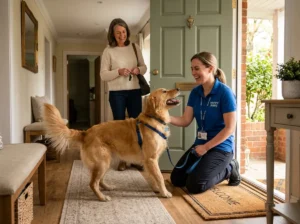
Responsible dog ownership means planning for the times you cannot be there. Whether it is a full work day, a business trip, or an unexpected emergency, your dog needs trusted care that does not rely entirely on your presence.
When to Hire a Professional Pet Sitter
Many first-time dog owners underestimate how quickly the need for professional care arises. A dog left alone for long hours — particularly a young or anxious dog — can develop behavioral issues that are difficult to reverse. A professional pet sitter provides in-home companionship, exercise, and routine that keeps your dog stable and happy during your absence.
Identifying and vetting a trusted sitter in your dog’s first few months — rather than scrambling when a need arises — is one of the smartest decisions a new dog owner can make. Start by reading about how to choose the right dog sitter for your pet so you know what questions to ask and what to look for before you book anyone.
Preparing Your Dog to Be Left with a Sitter
The earlier you introduce your dog to the idea of being cared for by someone other than you, the easier it becomes. A meet and greet before the first sitting visit, a thorough written care sheet, and a gradual introduction to the sitter’s presence all reduce the stress of handoffs. For a detailed walkthrough of how to make this process as smooth as possible, see our guide on how to prepare your dog for a successful dog sitting experience.
Knowing the Signs That Something Is Wrong
Year one teaches you your dog’s normal — their energy levels, appetite, bathroom habits, and personality. Any significant deviation from that baseline is worth paying attention to. Changes in appetite, lethargy, vomiting, limping, or sudden behavioral shifts are all reasons to call your veterinarian. Trusting your instincts as an owner and not waiting to see if things resolve on their own is a habit worth developing early.
Year One Is Just the Beginning
The first year is the most intense, the most educational, and ultimately the most formative period of your relationship with your dog. It asks a lot of you — in time, attention, patience, and consistency. But what it gives back is something that dog owners consistently describe as one of the most meaningful relationships of their lives.
Do the work in year one. Invest in training, establish a routine, build a support network, and get to know your dog as an individual. The foundation you lay now will determine the kind of dog you share your life with for the next ten to fifteen years — and that is a foundation well worth building carefully.
At Meg’s Dog Sitting, we love working with first-time dog owners and their dogs. Whether you need help with daily visits, overnight stays, or advice on building your dog’s care routine, we are here to support you every step of the way. Learn more about what professional dog sitting services include and how we can be part of your dog’s support network from day one.